Sensory Profile 2
SP-2
Standardised forms completed by caregivers and teachers to assess children's sensory processing patternsFILTER BY
AASP & Sensory Profile 2: Using and Interpreting the Sensory Profile in Clinical Practice · On Demand · 3 Hours
A103000314686
Qualification Level
This on-demand course is designed for users of the Sensory Profile 2 and/or Adolescent/Adult Sensory Profile. It includes an overview of Dunn's sensory processing framework, on which the test scores are based, and explains how to interpret the results and use these meaningfully to inform clinical practice.
The course features case studies presented by test authors Winnie Dunn and Catana Brown, demonstrating the application of theory to practice.
Victorian Department of Education customers: please view full training details for important prerequisites.
Full Course (11 Modules): ASD Assessment and Diagnosis Online Training • On Demand
A103000412627
Qualification Level
This comprehensive, on-demand course breaks down the entire assessment and diagnosis process into 11 distinct modules to provide in-depth and enriched learning for professionals in the ASD assessment field. The course thoroughly explores the ASD assessment, from consultation to reporting, and includes numerous case studies and video examples throughout the modules.
Standardised Assessment Tools • On Demand with Verve OT Learning
A103000428782
Qualification Level
Sensory Processing in Adolescents and Adults • On Demand with Verve OT Learning
A103000428785
Qualification Level
Sensory processing challenges do not end in childhood. They often continue into adolescence and adulthood, influencing participation, wellbeing, and everyday function. This workshop equips allied health professionals with practical tools to identify sensory processing difficulties, connect assessment findings to functional performance, and develop tailored recommendations that support meaningful outcomes.
- Publication date:
- 2014
- Completion time:
- 10 to 15 minutes
- Administration:
- Individual; Q-global administration, scoring, and/or reporting, or manual scoring
- Age range:
- Birth to 14 years and 11 months
- Qualification level:
- B

The Sensory Profile™ 2 family of assessments provides you with standardised tools to help evaluate a child's sensory processing patterns in the context of everyday life. These significantly revised questionnaires can help you determine how sensory processing may be contributing to or interfering with the child's participation in activities. The forms are completed by caregivers and teachers, who are in the strongest position to observe the child's response to sensory interactions that occur throughout the day.
Recommended Uses
The Sensory Profile 2 helps you:
- Identify and document the effect of sensory processing on a child's participation at home, school, and the community
- Contribute valuable information to a comprehensive assessment of the child's sensory strengths and challenges
- Develop effective treatment plans, interventions, and everyday remediation strategies
Content & Administration
Using age-appropriate questionnaires, caregivers and teachers report on the child's response to sensory events throughout the day.
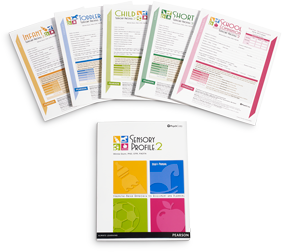
- Infant Sensory Profile: Caregivers complete this form for babies from Birth–6 months.
- Toddler Sensory Profile: Caregivers complete this form for toddlers aged 7–35 months.
- Child Sensory Profile: Caregivers complete this form for children aged 3–14 years.
- Short Sensory Profile: Caregivers complete this form for children aged 3–14 years. Items on this questionnaire, which are drawn from the Child Sensory Profile, are highly discriminating and provide quick information for screening and research programs.
- School Companion Sensory Profile: Teachers complete this form for their students aged 3–14 years.
Features & Benefits
- Offers updated content
- Presents information on the Infant, Toddler, Child, and School Companion forms in one manual—no need to purchase separate kits
- Reports percentiles for an additional level of analysis
- Gives you a choice of online or paper record forms to fit with your workflow
- Provides web-based scoring and reporting with Q-global for greater portability and ease-of-use
- Includes enhanced reporting options to give you the confidence to take the next steps
- Captures the child's responses to sensory experiences throughout the day, which helps shed light on factors that may be influencing the child's behaviour
- Presents a comprehensive view of a child's responses across settings, which helps facilitate discussion between families and professionals about strategies that support the child's participation in all contexts
- Offers you an evidence-based tool that is built on extensive evidence from the first editions of the Sensory Profile™, including international research demonstrating the usefulness of data

In each episode, you’ll meet someone who makes a profound difference in other people’s wellbeing every single day.
The following resources are available for SP-2:
Moments in Mind Podcast
Scoring and Reporting
Each form includes some combination of Sensory System, Behavioural, and Sensory Pattern scores:
- Sensory System scores: Auditory, Visual, Touch, Movement, Body Position, Oral
- Behaviour scores: Attention, Behavioural, Social-Emotional
- Sensory Pattern scores: Registration, Seeking, Sensitivity, Avoiding
- School Factor scores:
- School Factor 1 (Supports)
- School Factor 2 (Awareness)
- School Factor 3 (Tolerance)
- School Factor 4 (Availability)
Scoring and/or Reporting Options
Sensory Profile 2 is available on Q-global®: Pearson's web-based administration, scoring and reporting system. It enables you to quickly assess and efficiently organise examinee information, generate scores, and produce accurate, comprehensive reports - anywhere, anytime, on any internet-connected device.
Assessment and Planning Report: To link findings form the questionnaires to participation at home, in school, and in the community.
Multi-rater report: Facilitating sensory processing assessment in context.
Manual Entry: Option to use paper forms to administer the questionnaires, then use the Q-global platform to score and generate reports.