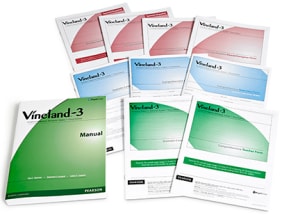
Vineland Adaptive Behavior Scales, Third Edition
Vineland-3
Support the diagnosis of intellectual and developmental disabilities- Publication date:
- 2016
- Completion time:
- NA
- Administration:
- Individual; Q-global administration, scoring, and/or reporting, or manual scoring
- Age range:
- Birth-90
- Qualification level:
- B
The leading instrument for supporting the diagnosis of intellectual and developmental disabilities.
Designed to meet ANY adaptive behaviour assessment need by offering:
- Interview, Parent/Caregiver, and Teacher Forms
- Comprehensive (full-length) and Domain-Level (abbreviated) versions of each form
- Online and paper administration options for all forms/versions
- Computerised or hand scoring for all forms/versions
Benefits
- Addresses today’s special needs populations, such as individuals with intellectual and developmental disabilities, autism spectrum disorder, and ADHD
- Updated with new norms and improved items
- Useful for diagnosis, qualification for special programs, progress reporting, program and treatment planning, and research
- Offers both respected semi-structured interview format which focuses discussion and gathers in-depth information, and also offers convenient rating forms
Major Enhancements to Parent/ Caregiver and Teacher Forms
- Separation of Interview and Parent/Caregiver Forms in Vineland-3
- Updated item content
- Updated norms
- Introduction of basal and ceiling rules to shorten Parent/Caregiver and Teacher Form administration
- Choice of digital or paper-based administration
Domain-Level Versions of Interview, Parent/Caregiver, and Teacher Forms
- Will provide scores for adaptive behaviour domains and the overall adaptive behaviour composite, meeting AAIDD and DSM-5 requirements for diagnosing Intellectual Disability
- Each domain will consist of items drawn from In-Depth form subdomains, e.g., Communication domain uses items sampled from Receptive, Expressive, & Written subdomains
- Age ranges will be 3 to adult for Interview & Parent/Caregiver Forms; 3 to 21 for Teacher Form
- Administration time will be approximately 20 minutes for Interview Form; 10 minutes for Parent/Caregiver and Teacher Forms
- Will not use basal and ceiling rules
The standard for measuring self-sufficiency
For over 30 years, Vineland Adaptive Behaviour Scales has been a leading measure of personal and social skills needed for everyday living. Psychologists and other professionals continue to depend on it to identify individuals who have Intellectual and Developmental Disabilities, developmental delays, autism spectrum disorders, and other impairments. Not only does Vineland aid in diagnosis, but it gives you valuable information for developing educational and treatment plans.
Covers the full spectrum of adaptive behaviour
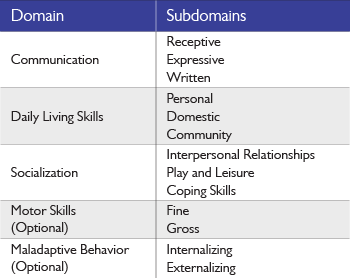
All Vineland-3 forms aid in diagnosing and classifying intellectual and developmental disabilities and other disorders, such as autism, Asperger Syndrome, and developmental delays. The scales are organised using three domains (Communication, Daily Living Skills, and Socialization) that correspond to the three broad domains of adaptive functioning specified by the American Association on Intellectual and Developmental Disabilities and by DSM-5. In addition, Vineland-3 offers optional Motor Skills and Maladaptive Behaviour domains for situations in which these areas are of concern.
Multipurpose Vineland-3
In whatever setting you work—education, social services, health care, criminal justice, or the military—like its predecessor, Vineland-3 helps you perform a variety of tasks:
- Support diagnosis of intellectual and developmental disabilities, autism, and developmental delays
- Determine eligibility or qualification for special services
- Plan rehabilitation or intervention programs
- Track and report progress
Many applications
With Vineland-3 you can measure adaptive behaviour of individuals with:
- Intellectual and Developmental Disabilities
- Autism spectrum disorders (ASDs)
- ADHD
- Post-traumatic brain injury
- Hearing impairment
- Dementia/Alzheimer’s disease

"I know what it’s like to be lost in language. Now, I help kids and professionals find their voices, for real."
Binh Doan, Speech Pathologist
Listen to Binh’s story