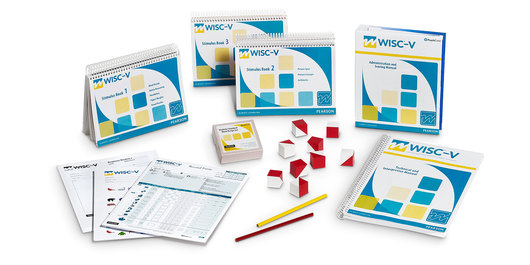
Wechsler Intelligence Scale for Children, Fifth Edition: Australian and New Zealand Standardised Edition
WISC-V A&NZ
Measure a child's intellectual ability- Publication date:
- 2016
- Completion time:
- Core subtests: 60 minutes
- Administration:
- Individual; Q-interactive - administration and scoring, Q-global scoring and reporting, or manual scoring
- Age range:
- Children aged 6:0 16:11
- Qualification level:
- C

“...when we found his sensory triggers and used his favourite Mario song as a coping tool, everything changed.”
Renee, Psychologist
Introducing the Wechsler Intelligence Scale for Children®–Fifth Edition, the latest version of the most proven trusted cognitive ability measure ever. Available in both a paper-and-pencil format and a digital format on Q-interactive®, the WISC–V delivers more flexibility and more content. It has been redesigned to give you a truly comprehensive picture of a child's abilities and it includes notable improvements to make identifying the issues—and finding the solutions—faster and easier, without sacrificing the Wechsler gold standard of excellence.
Content & Administration
The WISC–V gives you flexibility and interpretive power, along with access to more subtests, so you get a broader view of a child's cognitive abilities. An expanded factor structure provides new and separate visual spatial and fluid reasoning composites for all ages.
New Primary Subtests
- Visual Puzzles is a new Visual Spatial subtest that measures the ability to analyse and synthesise information
- Figure Weights is a new Fluid Reasoning subtest that measures quantitative reasoning and induction
- Picture Span is a new Working Memory subtest that measures visual working memory
Expanded and Updated Factor Structure
The test structure includes new and separate visual-spatial and fluid reasoning composites for greater interpretive clarity and a variety of levels of composites for interpretive options.
WISC-V Test Framework
The WISC-V provides a comprehensive measure of a child’s intellectual functioning across multiple cognitive domains.
Full Scale
| Verbal Comprehension |
|
| Visual Spatial |
|
| Fluid Reasoning |
|
| Working Memory |
|
| Processing Speed |
|
Primary Index Scales
| Verbal Comprehension |
|
| Visual Spatial |
|
| Fluid Reasoning |
|
| Working Memory |
|
| Processing Speed |
|
Ancillary Index Scales
| Quantitative Reasoning |
|
| Auditory Working Memory |
|
| Nonverbal |
|
| General Ability |
|
| Cognitive Proficiency |
|
Features & Benefits
More efficient and user-friendly
- Efficiently produce all primary index scores
- Significantly reduced testing time to obtain the FSIQ
- Simplified instructions with reduced vocabulary level, shorter discontinue rules, and refined scoring criteria
- Five primary index scores, the FSIQ as well as three of the five ancillary index scores can be obtained through the ten primary subtests
More interpretive power
- WISC–V provides statistical links to the WIAT-III, supporting flexible evaluation of specific learning disabilities
- Expanded score analysis approach highlights index- and subtest-level strengths and weaknesses
- Separate visual spatial and fluid reasoning composite scores provide greater clarity
- Expanded process scores enhance interpretation and understanding of performance
Updated psychometric properties
- Updated Australian and New Zealand standardisation sample (ages 6:0–16:11)
- Stratified norms by gender, ethnicity, education, and region
- Improved floor and ceiling sensitivity for a wider range of abilities
- High reliability across subtest and composite scores
Updated studies
- Includes new special group and validity studies
- Comparisons with WISC-IV, WPPSI-IV, WAIS-IV, WIAT-III, KTEA-3, Vineland-II, and BASC-2
- Validity for Q-interactive: construct, equivalence, and group-based comparisons
Users & Applications
Psychologists across schools, clinics, hospitals, and private practice use the WISC–V for:
- Identifying intellectual disabilities
- Diagnosing learning disabilities/disorders
- Evaluating cognitive strengths and weaknesses
- Giftedness assessment and monitoring recovery from brain injury
Earn a Pearson Clinical Badge
Upon completion, you will receive a badge to showcase your skills. With a digital credential, establish yourself as an expert in your field, providing a high level of credibility.
The following resources are available for WISC-V A&NZ:
Special Group Studies
- Q-interactive Special Group Studies: The WISC-V and Children with Intellectual Giftedness and Intellectual Disability
- Q-interactive Special Group Studies: The WISC-V and Children with Specific Learning Disorders in Reading and Mathematics
- Q-interactive Special Group Studies: The WISC-V and Children with Autism Spectrum Disorder and Accompanying Language Impairment or Attention Deficit/Hyperactivity Disorder
- WISC-V Interpretive Sample Report
- WISC-V Score Report
- WISC-V Nonmotor Table
- WISC-V Technical and Interpretive Manual Supplement
- WISC-V Technical Report 1: Expanded Index Scores
- WISC-V Technical Report 2: Testing Children Who Are Deaf or Hard of Hearing
- WISC-V Technical Report 3: Using the WASI-II with the WISC-V
- WISC-V Technical Report 4: Children with Hearing Differences Who Utilise Spoken Language and Have Assistive Technology
- Q-interactive Technical Report 8: Equivalence of Q-interactive and Paper Administrations of Cognitive Tasks: WISC-V
Tests in the WISC-V A&NZ harness the processing capacities of Q-interactive to provide new, more dynamic, cognitively demanding tasks that are unable to be delivered and scored with fidelity in a traditional paper format.
Test Components
Required items for administering WISC-V A&NZ on Q-interactive:
- 9780655796947 Response Booklet 1 - Coding and Symbol Search (Pack of 25)
- 0158978560 Coding Scoring Template
- 0158978552 Search Scoring Template
- 9780655796923 Response Booklet 2 - Cancellation (Pack of 25)
- 0158978579 Cancellation Scoring Template
- 015897946X Wechsler Standard Block Set
Digital Assessment Library
Learn more about our all-access pass to digital assessments.
Support
Existing Users
If you have an active Q-interactive or Digital Assessment Library (DAL) license, WISC-V A&NZ will be automatically added to your account.
Related Items