

Get Ready for BASC-4: What the Authors Want You to Know About the Latest Edition
by
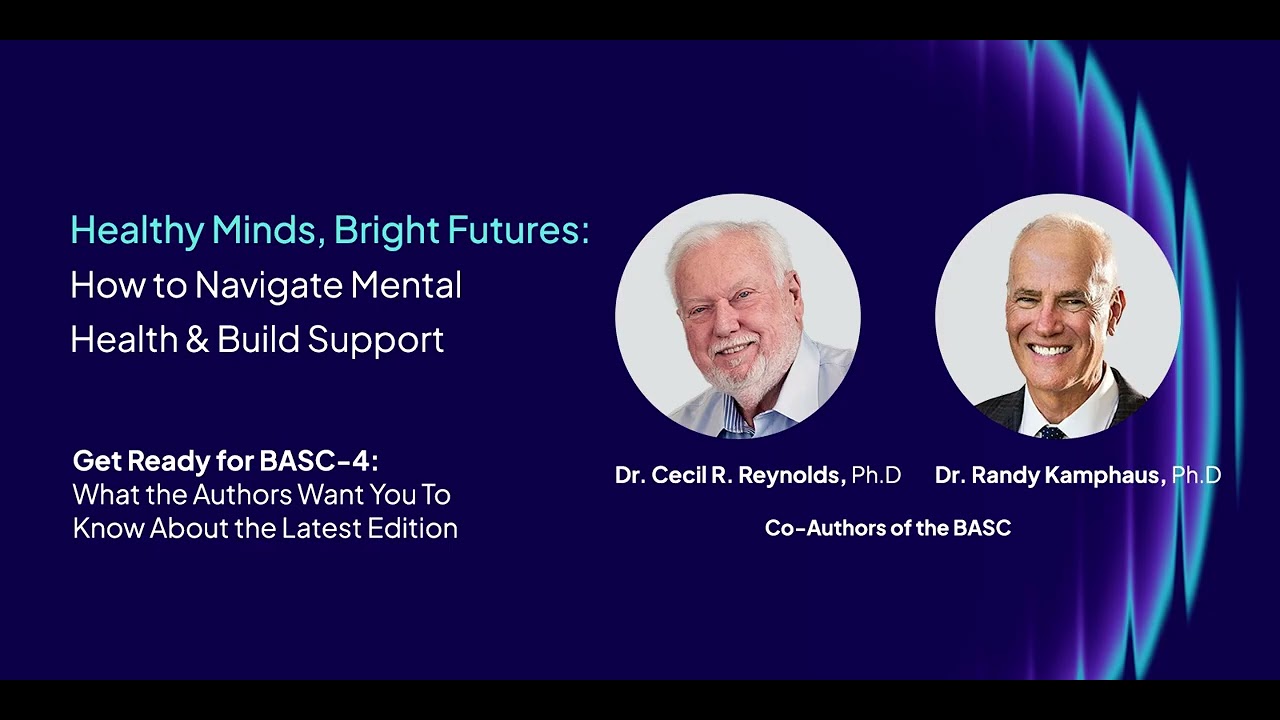
Mental health screening and assessment tools are more important than ever, and one of the most foundational tools—the Behaviour Assessment System for Children (BASC)—is soon to be released by Pearson in its fourth edition. As discussed in a recent episode of Healthy Minds, Bright Futures: How to Navigate Mental Health and Build Support, the BASC-4 includes important updates for clinicians and educators while retaining the evidence-based approach that has made it a trusted and effective suite of resources for nearly 40 years.
Play
What’s changing in BASC-4 — and what isn’t
The podcast episode featured Dr Cecil R. Reynolds and Dr Randy Kamphaus, authors of the BASC since its initial development. They explained how the BASC-4 incorporates content scales designed to help clinicians identify more effective interventions. “What we did with BASC-4 was undertake a very careful review of the literature, as well as consider what we were hearing from clinicians and other users of the BASC-3. In reviewing both the evidence base and user feedback, it became clear that the right approach was to enhance the system components of the BASC-4,” Dr Reynolds explained.
The authors and their team also updated the assessment’s language to better meet the needs of neurodiverse communities. This involved modernising terminology while maintaining diagnostic accuracy. The aim was to ensure the assessment remained relevant and genuinely inclusive in a way that would endure over time.
“Are the changes going to help clinicians help children? That’s the ultimate goal, and everything we did was focused on achieving that goal,” Dr Reynolds emphasised.
What remains unchanged in the BASC-4 is its strong emphasis on evidence-based practice. As Dr Kamphaus noted during the episode, modifying scales on the basis of only a small number of clinical studies—particularly where findings have not been replicated—is not a sound approach. Instead, the updated content scales are informed by a substantial and continually growing body of research. “The content scales are based on considerable evidence across studies, across researchers, and even across continents in some cases,” Dr Kamphaus noted.
Some of these changes may not be immediately apparent to users—in many respects, they are ‘under-the-hood’ updates—but they help ensure the BASC-4 remains linguistically appropriate and grounded in relevant, up-to-date research.
Early intervention with BESS
A key part of the BASC system is the Behavioural and Emotional Screening System (BESS). It was developed to support the early identification of mental health concerns and, in turn, enable earlier intervention.
Until recently, mental health conditions have not been screened for in their earliest stages in the same way as many physical health conditions. “It’s helpful to think of other examples from healthcare, such as pre-diabetes or identifying a pre-cancerous growth,” Dr Kamphaus explained. “We don’t have those definitions for pre-depression or pre-ADHD, but there is abundant evidence that those conditions actually exist.”
The BESS is designed to equip practitioners with a tool for early identification and intervention so they can support children as quickly as possible. Many of these early interventions involve lifestyle changes that are less costly and more easily implemented than interventions required at a later stage.
“Educators and other personnel can deliver relaxation or wellbeing interventions, along with a wide range of other approaches that may help prevent the development of a mental health disorder later on,” Dr Kamphaus noted.
He also emphasised that “the BESS simply provides an indication of whether risk—or, in the worst-case scenario, a disorder—is present. If a screening result is positive, it is important to follow up with a comprehensive assessment to gain a better understanding of what is happening with the child and what support may be needed.”
Dr Reynolds and Dr Kamphaus also stressed that the BASC-4 BESS is not intended to drive a single referral based on one positive screening result. “If the referral question is, let’s say, suspected ADHD, we would not recommend following up with an ADHD-only measure because there may be an alternative cause for that inattention or hyperactivity that you wouldn’t identify,” Dr Kamphaus said.