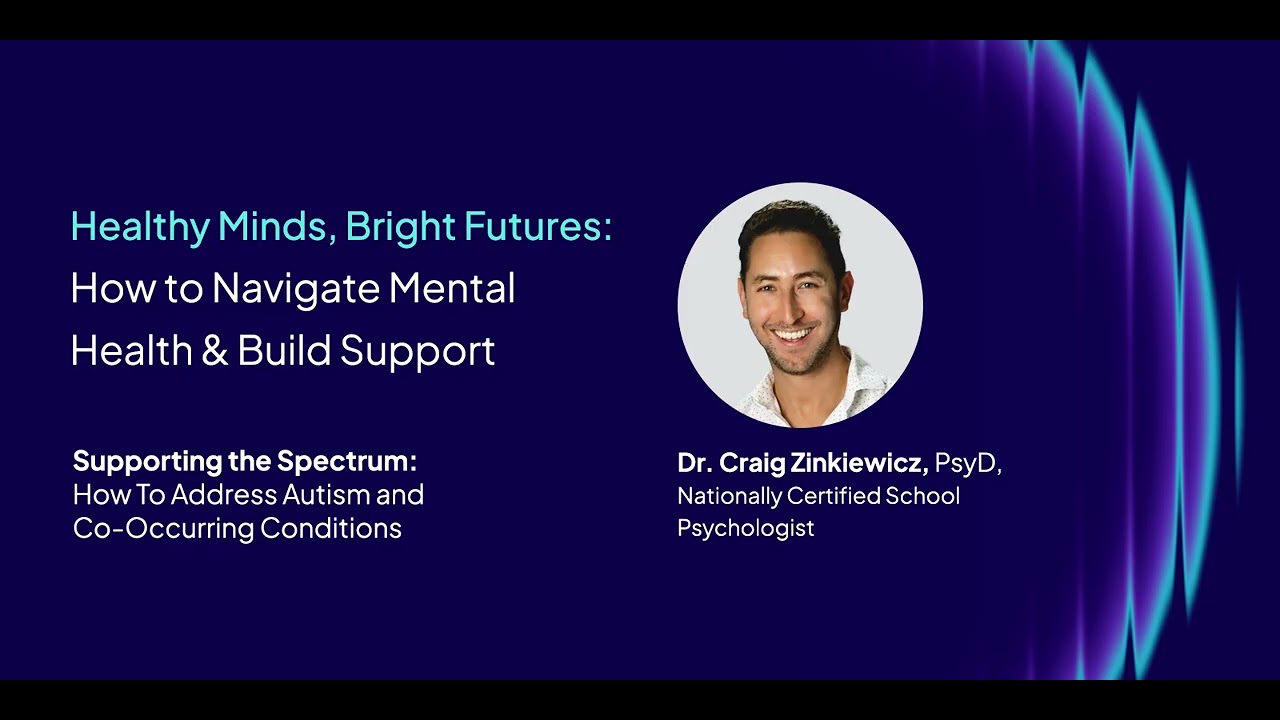

Supporting the Spectrum: How To Address Autism and Co-Occurring Conditions
by
In recent decades, an increasing number of children have been diagnosed with autism spectrum disorder (ASD) across the U.S. According to the latest CDC data, the number of 8-year-olds identified with ASD is about 1 in 31. However, as discussed on a recent episode of our podcast, “Healthy Minds, Bright Futures: How to Navigate Mental Health and Build Support,” there is more to that number than meets the eye.
Play
Rates of ASD occurrence vary considerably across geographical regions. For example, ASD is identified in approximately 1 in 103 children in Texas, compared with 1 in 19 children in California. As nationally certified school psychologist Dr Craig Zinkiewicz, PsyD, explained on the podcast, diagnostic criteria for ASD have continued to broaden over time.
“It’s likely that the number of Level 3 children — those who require the highest level of support — is not changing significantly. Instead, more Level 1 children who exhibit milder symptoms or sit near the edge of the spectrum are being diagnosed because the criteria are becoming more sensitive and inclusive of a wider range of symptoms,” Dr Zinkiewicz explained.
This broader diagnostic framework can be beneficial, as it allows more individuals to access appropriate assessment and support. However, it also introduces greater nuance and scope for clinical interpretation when diagnosing ASD, which can present challenges for clinicians and educators seeking to determine and provide the most appropriate level of support for students.
The importance of screening in schools and clinical settings
Early intervention for any condition is critical, whether it’s a behavioral or sensory issue or academic challenges. Dr. Zinkiewicz noted on the podcast that more standardized screening processes can lead to earlier interventions, and treating these screenings like routine hearing or vision tests in schools could be very beneficial.
“It’s not about getting more kids into clinical evaluations — it’s about standardizing things so it’s not up to each teacher or caregiver to flag when a child may be struggling or need more support,” he said.
Variability in diagnostic criteria is another challenge with ASD. Not only is there nuance in applying that criteria, particularly for Level 1 children, but there are also many co-occurring conditions that can complicate the picture for clinicians. These can include obsessive-compulsive disorder, anxiety or attention-deficit/hyperactivity disorder (ADHD), among others.
For school psychologists and their colleagues, relying on the Individuals with Disabilities Act (IDEA) and identifying any categories that apply to a certain child are critical to creating an individualized education plan (IEP) for a child. Diagnosing ASD doesn’t happen in schools; it’s made in a clinical setting. Thus, school psychologists should make their screenings as robust as possible by making observations in the school environment and talking with teachers and caregivers. This approach enables their team to develop an effective IEP and to empower caregivers with a well-rounded source of information, should they decide to move to a clinical evaluation.
Tools are extremely important in this process as well, and as Dr. Zinkiewicz discussed on the podcast, clinicians have many options. “The BASC-3 from Pearson is a well-known, broad-based assessment that can serve as a strong starting point,” he said. “Schools have occupational therapists, speech pathologists and others who can weigh in at this stage, too, which is very valuable.”
The Autism Spectrum Rating Scales is another important tool. It can help clinicians address the many nuances in symptom presentation and gather a rich amount of data to guide IEPs, evaluations and support for students.
Collaborating for student well-being
ASD is not only managed in schools, of course. Working with caregivers and families is vital to providing support. Educators and clinicians have the opportunity to help parents feel confident in their child’s growth and development, essentially showing them that their child isn’t necessarily obstinate or not listening, but that he or she has different needs.
Involving caregivers in IEP development is required by law, but beyond those regulations, it’s essential for better student outcomes to ensure continuity between the school and home environments. Working collaboratively, communicating often, and avoiding clinical jargon with caregivers are key steps to supporting students in and out of the classroom.
This matters regardless of where a child may be on the autism spectrum. The variability in ASD diagnostic criteria can make diagnosis a challenge, but as Dr. Zinkiewicz reiterated for listeners, it’s most important to use the tools we have and not feel stuck if you don’t have the “perfect” answer.
“Don’t be paralyzed,” he said. “You’ve got to use what you’ve got and be as comprehensive as possible so you can say you did everything you could to peel apart the diagnostic criteria.”
Learn more about supporting students with ASD by listening to the episode of “Healthy Minds, Bright Futures,” and visiting Pearson’s resources for autism.